
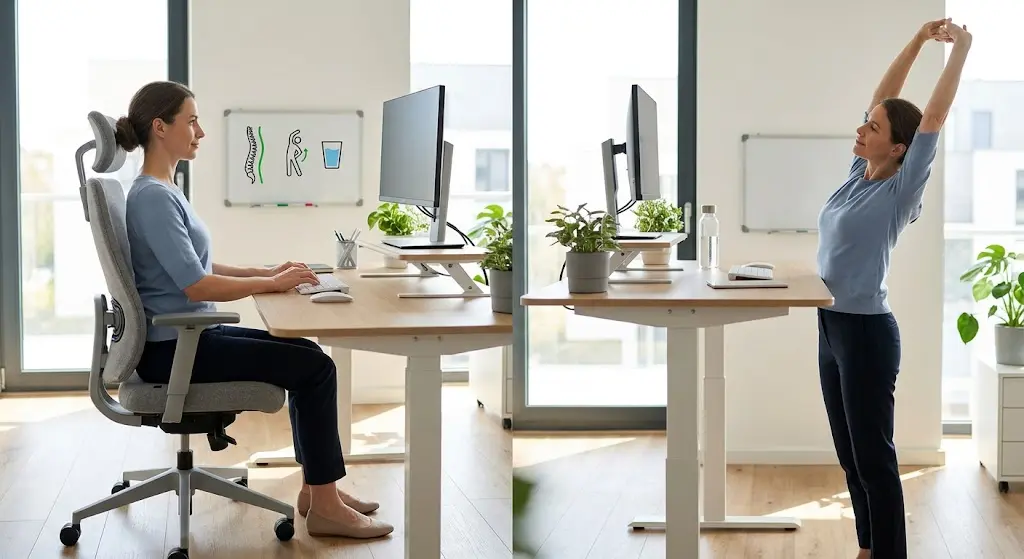
Millions of people now spend most of their working day in a chair. We commute by sitting, work by sitting and unwind by sitting. The human body was built to move, so it is not surprising that long hours at a desk can leave us aching, stiff and tired.
What prolonged sitting does
Sitting is not harmful in itself. The problem is sitting for hours without a break. When you stay in one position, the muscles that support your spine work in a constant, low-level way and eventually tire. The hip flexors shorten, the glutes switch off and the upper back rounds forward. Over time this can lead to neck tension, shoulder pain and lower back discomfort.
Beyond aches, long periods of inactivity are linked with poorer circulation, slower metabolism and a higher risk of conditions such as heart disease and type 2 diabetes. Importantly, researchers have found that regular exercise reduces some of this risk but does not cancel it out completely. Breaking up the sitting itself matters.
Set up your workspace
A few adjustments can reduce strain considerably.
Chair. Sit with your hips and knees at roughly right angles and feet flat on the floor. Your lower back should be supported, either by the chair or a small cushion.
Screen. Position the top of the screen at or just below eye level and about an arm’s length away. If you use a laptop, consider a separate keyboard and a stand, since a laptop on its own forces you to choose between a hunched neck and raised arms.
Keyboard and mouse. Keep them close so your elbows rest near your sides at about ninety degrees. Your wrists should stay straight rather than bent up or down.
Lighting. Avoid glare on the screen, and make sure the room is bright enough that you are not leaning in to read.
No arrangement is perfect for eight hours, which brings us to the most important point.
Move little and often
The best posture is your next posture. Aim to change position at least every thirty minutes. You do not need a formal workout. Try these small moves:
- Stand up when you take a phone call.
- Walk to a colleague instead of sending a message.
- Refill your water often, which gives you natural movement breaks and keeps you hydrated.
- Set a gentle reminder to stand and stretch.
- Hold meetings while walking when it suits the topic.
A standing desk can help, but standing still for hours brings its own problems. Alternating between sitting, standing and moving is the real goal.
Stretches you can do at your desk
These take less than a minute and can be repeated through the day.
Neck release. Sit tall and gently tilt one ear towards your shoulder. Hold for twenty seconds and switch sides.
Shoulder rolls. Lift your shoulders towards your ears, roll them back and down. Repeat ten times.
Chest opener. Clasp your hands behind your back, lift them slightly and open your chest. Hold for fifteen seconds.
Seated spinal twist. Turn gently to one side, holding the back of the chair. Hold, then switch.
Hip flexor stretch. Stand, step one foot back and gently push your hips forward. Hold for twenty seconds each side.
Strengthen what sitting weakens
Stretching helps, but strength protects. Exercises that target the back, glutes and core, such as bridges, rows and planks, help your body hold a good position for longer. Even two short sessions a week can make a noticeable difference.
When to seek help
Mild stiffness usually settles with movement and better habits. See a doctor or physiotherapist if you have pain that lasts more than a couple of weeks, numbness or tingling in your arms or legs, pain that wakes you at night or weakness in a limb. These signs need proper assessment.
Small changes, big difference
You do not have to overhaul your life or buy expensive furniture. Start by adjusting your screen height and setting a reminder to stand every half hour. Within days, many people notice less tension and more energy. A short walk at lunchtime is a good place to begin. Consistency beats intensity. Your future self, and your spine, will be grateful.